Literature Review: Draft
Introduction to the Data Science Biocultural Diversity (DSBD) Framework
Background:
Societal Issues Highlighted by a Pandemic
In 2019 a novel coronavirus was recorded; by its official 2020 designation as a pandemic, the modern world had to grapple with, and react to, its many shortcomings (WHO, 2020; Allam, 2020). This situation sparked numerous investigative reports into societal inequities that threatened to inundate many healthcare and economic systems. Moreover, it highlighted extreme cases of bureaucracy, corruption, discrimination, and even racism (Feffer, 2020; Terziev & Georgiev, 2020; Lancet, 2020; Ortega & Orsini, 2020; Haug et al., 2020; Weine et al., 2020; Waymer, 2020; Corburn et al., 2020; Gravlee, 2020; Mendes Luı́s, 2020; Dave et al., 2020). Systemic failings in governments have powerful direct and indirect impacts on the planet and its inhabitants.
Notably, as modern commerce ground to a halt, the environment appeared to thrive. Many early reports noted that air quality had drastically improved in some areas (Newsroom, 2020; Bauwens et al., 2020; He et al., 2020; ARB, 2020; Mahato et al., 2020). Wildlife began to flourish in some areas, and these animals were even spotted venturing out into once-bustling commercial sectors (Christian et al., n.d.; Weston & readers, 2020; Garlicky, 2020; Winter, 2020). In some locations, there were even notable reductions in accidental animal killings along typically high traffic routes (Katz, 2020).
However, the progress made during this period was highlighted as being very fragile; and that the period of lockdown has not benefited all forms of life (Garlicky, 2020; Fine Maron, 2020; Davies, 2020; Locatelli, 2020). In extreme cases, the funding of research and preservation of species (Simon, 2020; Corlett et al., 2020), of poacher policing (Fine Maron, 2020; Locatelli, 2020; Buckley, 2020), and of care for captive animals (particularly those areas reliant on public gatherings of locals and tourists), experienced reductions (Garlicky, 2020; Abraham, 2020; Greenfield, 2020; Fine Maron, 2020; Davies, 2020; Locatelli, 2020; Buckley, 2020). Moreover, early air quality improvements have been diminished by continuous wildfires worldwide (Carlsen et al., 2020; Houghton, 2020; Neill, 2020; Hamedy, 2020; ARB, 2020). Notably, the strength and duration of these, formally natural, fires are increasingly exacerbated by human action; this ranges from deliberate destruction (Sullivan, 2019; Pedroso & Reverdosa, 2020; Garcia, 2019; Spring & Marcello, 2020), to careless destruction (Jack, 2020; Shepherd, 2020), but also includes that which is facilitated by inadequate climate policies (Tollefson, 2020; Harvey, 2020; Worland, 2020; Gupta et al., 2020). The tenuous nature of these environmental improvements signaled the power of individual actions.
Societal Reflection
This time of isolation did facilitate a much needed period of reflection in society (He & Harris, 2020). Some families found that isolation improved their relationships, while others found the opposite to be true (as cases domestic abuse increased) (Mazza et al., 2020; Campbell, 2020; Bradbury-Jones & Isham, 2020; Jones, 2020; Bullinger et al., 2020; Mamun et al., 2020). Modern technology bridged the physical gap of in-person communications. However, while some people struggled with competently using the gamut of available modern communication tools, others struggled to merely gain access to these resources (Garbe et al., 2020; García et al., 2020; Van Lancker & Parolin, 2020; Collis & Vegas, 2020; Adnan & Anwar, 2020).
During this difficult time, individuals became keenly aware of their mortality and their perceived needs. To better cope with such a concerning situation, some sought structure and meaning through the review of and reflection on various texts; well-known psychological theories, concerning the prioritization of needs, include Maslow’s Hierarchy of Needs (Matias et al., 2020; Casale & Flett, 2020; Wong et al., 2020). Some people actively sought, yet struggled to address their basic physiological needs (Corburn et al., 2020; Van Lancker & Parolin, 2020; Steavenson, 2020; Pulighe & Lupia, 2020; Power et al., 2020), while also attempting to address their needs for safety (Mukherjee & El-Bassel, 2020; Mazza et al., 2020; Campbell, 2020; Bradbury-Jones & Isham, 2020; Jones, 2020), love and belonging (Berg-Weger & Morley, 2020; Campbell, 2020), esteem (Bhasker & Greve, 2020; Wong et al., 2020), and even self-actualization (Casale & Flett, 2020; Wong et al., 2020; Salari et al., 2020).
Ultimately, this reflection period facilitated the review and reprioritization of personal needs and the rethinking of modern institutions. Such reflection aided in more purposeful consumer patronage, some reconsideration of corporate social responsibility and marketing philosophy, and a general increase in actively expressing individual values and beliefs (He & Harris, 2020; Dave et al., 2020). Many persons were also roused to solicit improved equality in justice systems and access to opportunities (Callimachi et al., 2020; Miriti et al., 2020), fair and free elections (Begumhan Bayhan, 2020; BBC, 2020), improved environmental standards (Friedman & Rosen, 2020; Reuters, 2020), and expanded access to resources associated with their basic needs (Orso & Goodin-Smith, 2020; Haag & Stevens, 2020). The complications of modern societies had been building up over time, worldwide; yet, in a time where access to vital resources became restricted, many individuals were driven to reflect and actively address the adequacy of their societal-systems to provide for their perceived needs.
Data Science, Digital Humanities, and Biocultural Diversity
Years of study may be required to become fully aware of the actual societal and environmental toll of the most recent pandemic in modern history. Globally, there is a base understanding of the utter urgency with which all nations are attempting to cope with the many disruptions caused by the pandemic. In light of the lastest pandemic, academics, and citizen scientists alike, openly shared data, and contributed findings as quickly as possible (Kupferschmidt, 2020; Gewin, 2020). Even data science enthusiasts, like Avi Schiffmann, were able to make remarkable contributions to global efforts. Schiffmann, a US high schooler, gained worldwide fame for this ability to employ his web-scraping skills to create the first online visual case tracker dashboard (Crane, 2020; Meisenzahl, 2020; Schiffmann, n.d.); it was free and globally accessible. Albeit a fledgling data scientist, Schiffmann’s creation, through the combination of his interests and skills, was eventually monitored and followed by various institutions and individuals worldwide, while authorities were scrambling to allocate the necessary resources to accomplish this task (Samarrai, 2020).
During the 2020 SARS-CoV-2 pandemic, global citizens began critically assessing existing problematic policies and strove to create and cement beneficial policies for the future. There were many instances of institutions revisiting previously overlooked policy proposals, particularly those related to the environment, in concerted efforts to provide immediate and lasting projects of value to the public. On a small-scale, some institutions sought and secured approvals for extending nature reserves (Neill, 2020). On a larger-scale, despite some regulatory rollbacks, as of July 7th, climate activists saw celebrated the abandonment of the Atlantic Coast Pipeline, and the shut-down and emptying of the Dakota Access Pipeline, pending a long-awaited thorough environmental review (Simroth, 2020; Cowan, 2020; Tamborrino, 2020; Lavelle, 2020) Additionally, academic investigations into biodiversity conservation were renewed (Bates et al., 2020). It appeared that genuine value could be generated from studies in the areas of Digital Humanities (DH) and Biocultural Diversity (BCD), as these fields specifically focus on the intrinsic connection between societal structures and its possible harmony with their surroundings.
Digital Humanities can be interpreted as the intersection of computing (or digital technologies and humanities disciplines; it is regarded as the technology space where many digital humanists undertake the process of “translating texts into digital spaces and data or translating digital and quantitative information into new texts and interpretations” (Levenberg et al., 2018). The field of digital humanities is quite diverse, and flexible, meaning that skills acquired can be applied to various areas. For example, an understanding and appreciation of linguistics is often helpful when working in this field; a digital humanities task related to linguistic analysis and marketing could entail an analysis of YouTube Play comments to aid in answering a question about targeted audiences (Levenberg et al., 2018).
The ability to reliably collect and manipulate a large set of texts is crucial; one may employ computational techniques from “natural language processing, corpus linguistics, distant reading, or broad reading” (Levenberg et al., 2018). These techniques assist with data processing; this can encompass data aggregation and analysis of large sets of structured or unstructured texts (Levenberg et al., 2018). Depending on the purposes of their research, it is said that different disciplinary approaches use distinct sets of algorithmic or programmatic approaches to interpreting the contents of texts (Levenberg et al., 2018).
Digital humanities can be the strategic and systematic implementation and utilization of digital resources on the study of the humanities and further analysis of their application. For example, this can take the form of works in archeology. Undertakings can produce an intricate reconstruction of the social and environmental history of various areas of a bygone era (like developing “Patterns of Etruscan Urbanism” (Stoddart et al., 2020)); this area is particularly useful when attempting to process historical documents related to time data (Ortman, 2019). Additionally, these skills can be useful in recreating documents (Ortman, 2019), catalog images (Ziegler Delgado, 2020), using Computer Vision (Cornia et al., 2020), and using various forms of machine translation to handle text processing (Ye & Boot, 2020).
Need to expand this area a bit; may need more sources
In Mattmann’s “vision for data science” he suggested that “for the specialism to emerge and grow, data scientists will have to overcome barriers that are common to multidisciplinary research” (Mattmann, 2013). Luisa Maffi was the co-founder and director of Terralingua and a pioneer in the Biocultural Diversity domain of research (Terralingua, 2019; Terralingua, 2020; Terralingua, 2014; Maffi & others, 2007; Maffi, 2005). She revealed the interrelated (and possibly coevolved) nature of the diversity of all forms of life within a complex socio-ecological adaptive system. BCD projects tend to have some connection to conservation efforts, and have strong ties to linguistics; according to Maffi, biological, cultural, and scientific complexity add to the various forms of diversity in life (Terralingua, 2019; Bates et al., 2020; Buckley, 2020; Corlett et al., 2020; Maffi & others, 2007; Maffi, 2005). BCD has been regarded as an evolving perspective for examining the interconnection of living beings and their environments, particularly regarding conservation efforts (Myers et al., 2000); one source regards it as highlighting the “interrelatedness between people and their natural environment” (Buizer et al., 2016). Maffi has dedicated much of her work linguistics (Maffi, 2005), particularly the preserving and reinvigorating endangered languages (Maffi, 2002; Maffi, 2003).
While BCD adaptable to every environment, it is very apt for positive projects in rural areas or the countryside communities (with limited infrastructure) and even indigenous communities (Terralingua, 2019; Terralingua, 2020; Terralingua, 2014; Maffi & others, 2007; Maffi, 2005). Often these communities highly value their environment as it sustains them. For example, Brazil is a country with vast natural resources, and it is home to various indigenous communities (with many unique languages).
In one Brazilian study, the thoughtful application of BCD actions aided in counteracting adverse social outcomes where government interference in local nature governance occurred (missing reference). Island countries such as Saint Lucia, in the Caribbean, has a local heritage language of Saint Lucian Kwéyòl language that is currently in a precarious state; no language vitality census has been attempted since the late 1940s (Irvine, 2020; Hilaire, 2008; St-Hilaire, 2011). The vocabulary of this language is intrinsically tied to objects in the natural environment. Moreover, the country’s national cultural policy outlines even outlined a desire for Saint Lucian Caribbean people to “be aware of the importance of living in harmony with the environment” (UNESCO, 2017; CDF, 2019).
Another work acknowledged Maffi’s expression of concern for the twofold destruction of local cultures and wilderness in her early writings, yet the work highlighted the possible positive outcomes with diligent proactive efforts. It was believed that acknowledgment of BCD would facilitate a move from a “crisis narrative to a dynamic narrative” (Elands et al., 2019). Additionally, the work highlighted that BCD studies do not solely occur in rural areas; observations could be made in cities to assist with improving living standards and encouraging urban green infrastructure projects (Elands et al., 2019).
Cities are increasingly considering BCD projects as a means of rapidly ameliorating living conditions. BCD for has been recognized for its ability to foster creative solutions to addressing environmental concerns, and aid in a more forceful embedding of ecology into decision-making (beyond standard ecological concepts such as Ecosystems Services (ES)) (Buizer et al., 2016); one work insisted that researchers and policy-makers carefully consider including BCD in their “conceptual repertoire” related to environmental projects as a means of addressing the “value-orientations of all stakeholders” (Buizer et al., 2016).
While the concept of biocultural diversity is relatively novel, there are increasing bodies of works constantly being developed, even during the 2020 SARS-CoV-2 pandemic. In fact, the pandemic appeared to be creating a unique opportunity to academically assess the interrelatedness of entities existing and enduring through the crisis; as noted earlier, there are unusual increases and decreases of interactions between humans and animals, and between humans and their environments (Reyes-Valdés & Kantartzi, 2020; Bates et al., 2020; Buckley, 2020; Corlett et al., 2020).
For example, one new work during this time acknowledged the concept’s typical associations with transdisciplinary projects and the concept’s involvement with linguistic, cultural, and biological research methods in tandem with numerous statistical and mathematical approaches (Reyes-Valdés & Kantartzi, 2020). However, the work then demonstrated the adaptability of the concept to biological data, by connecting transcriptome analysis bearing a biological interaction structure of a cultural group. Unique relationships were able to be identified through the lens of the cultural group component. The findings were scientifically supported, as it was said that “the specificity and specialization indices have a direct mathematical relationship with the biocultural complexity, which can be interpreted as the effective number of biocultural units equivalent to the observed data” (Reyes-Valdés & Kantartzi, 2020).
May need to expand this area a bit; may need more sources
Motivation is essential to change, however, to properly allocate resources, data collection and analysis should occur; based on the details above, it does appear that the areas of digital humanities and biocultural diversity do acknowledge and respect careful scientific observation and accounting of findings. Data science offers a plethora of tools in which to explore our world. However, it is often a difficult task to decipher what tools to use and when. Developing the skill and capacity to achieve this requires quite a bit of study. It also requires a significant degree of concern and compassion to dedicate resources into research that may not have a direct, immediate, or substantial financial reward.
Establishing a Framework:
Maslow’s Foundational Framework
In line with the pursuit of societal and environmental reform, a simple humanitarian framework was considered as a base structure to direct a researcher to relevant concepts and tools. In 1943, an article entitled “A Theory of Human Motivation” was published to the Psychological Review. The author, Abraham Maslow, put forth a psychological theory that would evolve into a recognizable visual business tool (Maslow, 1943; Mcleod, 2020). He stated that there are “at least five sets of goals, which we may call basic needs”; this was recognized as the five-tiered hierarchy model of human needs as a motivational theory in psychology. Maslow stated that man could be viewed as a “perpetually wanting animal”; that when a need is reasonably satisfied, the subsequent prepotent (‘higher’) need arises in succession, to “dominate the conscious life, and to serve as the center of organization of behavior, as gratified needs are not active motivators” (Maslow, 1943; Mcleod, 2020).
Maslow recommended that the base tier be satisfied before individuals attend to those above, yet, he did later clarify that one’s absolute satisfaction of a need would not limit movement between layers (as personal prioritization can vary) (Maslow, 1943; Maslow, 1969; Maslow, 1981; Maslow, 1964; Mcleod, 2020). One should think of these as continuously overlapping levels, as not everyone will move through the hierarchy in a uni-directional manner.
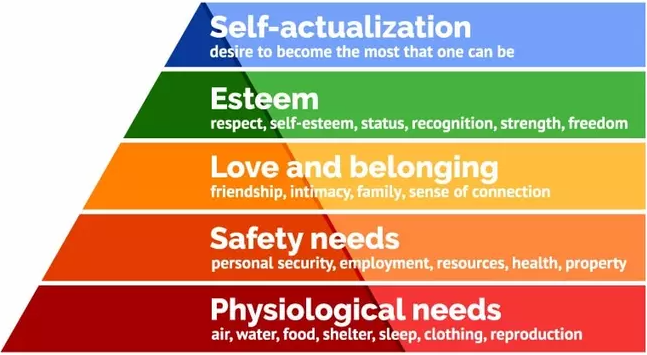
The five-tiered hierarchy of human needs are physiological, safety, love and belonging, esteem, and self-actualization (Maslow, 1943; Mcleod, 2020). The bottom-tier deals with physiological needs related to the biological requirements for human survival, like air, food, drink, shelter, clothing, warmth, sex, sleep. Safety needs are related to security (including emotional security and financial security) and safety (including law and order, freedom from fear, social stability, property, health, and well-being). Love and belongingness needs pertain to affiliating (being part of a group), friendship, intimacy, trust, acceptance, and receiving and giving affection and love. Esteem needs encompass concepts of esteem for oneself (dignity, achievement, mastery, independence) and the desire for reputation or respect from others (notably status and prestige). The top-tier deals with self-actualization needs are related to the realization of personal potential, self-fulfillment, seeking personal growth, and peak experiences.
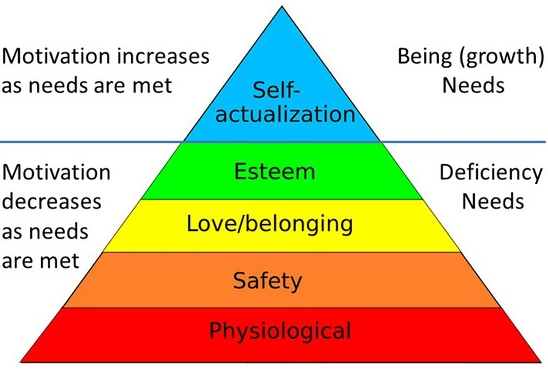
Overtime versions of this framework, bearing more than five tiers, were created. In an eight-tiered version, esteem needs are expanded and segmented out to form a cognitive needs level (ranked above it) (Maslow, 1969; Mcleod, 2020). Cognitive needs are related to knowledge and understanding, curiosity, exploration, need for meaning, and predictability. The aesthetic needs reside above this. These needs are an appreciation and search for beauty, balance, simplicity, and form, and among other matters.
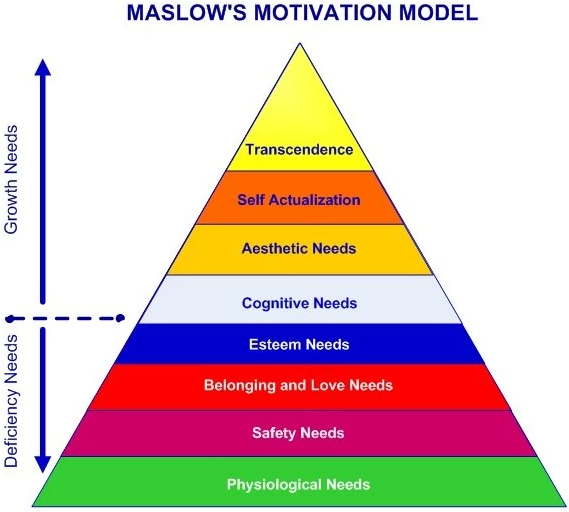
Finally, transcendence needs, usurp self-actualization needs’ top-tier position. Maslow was passionate about the topic of transcendence to the point that he created a work that explored the various meanings of the word, and how one may achieve each definition (Maslow, 1969). Transcendence needs can relate to a person motivated by values that transcend beyond the personal self; these may relate to service to others, the pursuit of science, and religious faith, among other matters (Maslow, 1969; Mcleod, 2020).
It encompasses transcending the ego, self, selfishness, ego-centering, and even mentions a “metahuman” or “B’human” classification. The latter is related to one becoming divine or godlike (to go beyond the merely human); this is where one can “rise above dichotomized nationalism, patriotism, or ethnocentrism, in the sense of “them” against “us” (Maslow, 1969). He explained that “to be a full member of the human species does not mean repudiating the lower levels; it means rather including them in the hierarchical integration, e.g., cultural pluralism, enjoying the differences, enjoying different kinds of restaurants with different kinds of food, enjoying travel to other countries, enjoying the ethnological study of other cultures, etc.”
Maslow’s framework is not new, yet it continues to be employed to explain human motivation across different fields at micro and macro-levels. Notably, this structure has had educational applications; Maslow is said to have adopted a holistic approach to education and learning; that students’ basic physiological needs, of food and rest, should be addressed before their cognitive needs (Maslow, 1981; Maslow, 1964; Mcleod, 2020). In the medical field, researchers recently used this framework to understand adolescent depressive symptoms over time and to identify the factors contributing to student nurse success (Crandall et al., 2020; Freitas & Leonard, 2011).
Maslow’s theory was also employed in economic development and national intelligence discussions (Özdağlar, 2015; Burhan et al., 2014). As recently as 2011, Diener is said to have reviewed the framework as part of a study that provided a profound impact on government accountability regarding public policy reforms for the well-being of their citizens (Diener & Biswas-Diener, 2011; Villarica, 2011). Diener is said to have created a survey of thousands of people from 123 countries in an attempt to reveal the quintessential components of the universal needs that make individuals happy; Diener’s model was to be more than a theory, but a happy approach to life was based on factors of Attention, Interpretation, and Memory (AIM) (Diener & Biswas-Diener, 2011; Villarica, 2011). It highlighted the roles of governments and individuals in effectively pursuing happiness for themselves and others.
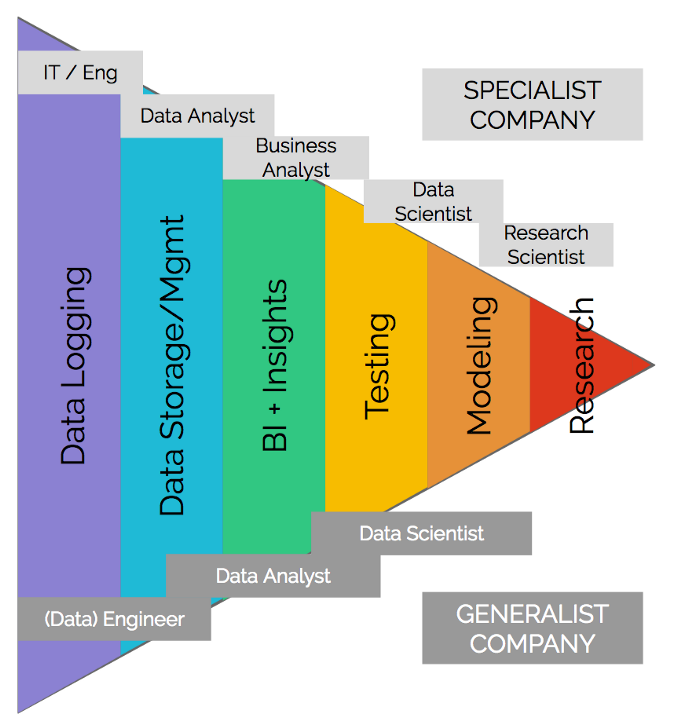
Notably, Maslow’s hierarchy has also been informally applied to the field of data science. While unable to find many scholarly publications on the matter, a few data science enthusiasts have attempted to explore a hierarchy of data science needs; a visual interpretation of the skills associated with this fairly new field. In 2017, Monica Rogati was credited with the creation of a similar pyramid structure that focuses on what skills impact the careers of individual data scientists; at the base would be data collection, and then movement and storage, exploration and transformation, aggregation and labeling, and ended with learning and optimization (related to artificial intelligence, deep learning and well as experimentation and simple machine learning algorithms among other details) (Rogati, 2017).
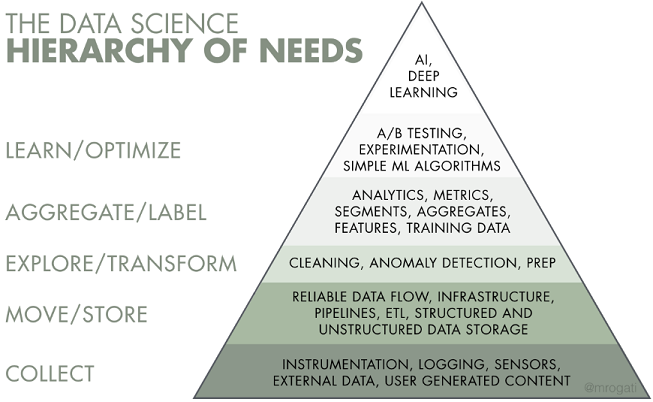
In 2018, Hugh Williams revisited this framework and began to consider the unique data science needs of individual companies; he incorporated the need to consider the needs of specialist companies and well as generalist companies (Williams, 2018).
Resurgence of Maslow’s Hierarchy During the 2020 SARS-CoV-2 Pandemic
Academics have been particularly keen to revisiting Maslow’s hierarchy, during the pandemic. One academic strove to explore the needs of various persons while they remain in various states and stages of isolation through the lens of Maslow’s hierarchy (Matias et al., 2020). Here they paid particular attention to how homeostasis operates at all seven levels of Maslow’s hierarchy and discussed the homeostasis system linking low self-esteem with negative affect, comfort eating, and overweightedness (Matias et al., 2020).
In another work, by Casale and Flett, Maslow’s hierarchy was used to explore the impact of isolation and the resulting limitations of goal fulfillment, self-actualization, self-esteem, and relatedness during a global health care crisis (Casale & Flett, 2020). Here, the structure highlighted the high importance of physical proximity for some, as it aids with creating a sense of belonging and stability for them. When this need is unmet, persons highly focused on their interpersonal needs could experience raised anxiety levels. Isolation was seen to enhance fears of missing out on experiences and interaction; sufferers were also found to question their significance and the stability of their relationships due to the limitations presented. Ultimately, one could indeed infer that is this very innate need for a sense of contact, provide for one’s basic physiological needs or satisfaction of various other needs, that has made efforts to reduce infection rates challenging.
Additionally, this structure has also been recently used to better explore the needs of various employees in their workplaces. Another academic employed this structure to protect emergency health care workers’ mental health during the SARS-CoV-2 pandemic (Wong et al., 2020). To better deal with the constant chaos of their workplaces, individual reflection on Maslow’s hierarchy was believed to provide a structure for prioritizing their, personally essential, needs (Wong et al., 2020).
Flaws associated with Maslow’s framework
Maslow’s framework, however, is not without critique. Despite its ubiquity of application, and being repeatedly proven to evoke an innate recognition of human nature in oneself and others, some contest the methodology for his studies. Some stated that it was problematic that Maslow was said to have been very selective with the individuals chosen for his research; he selectively pursued highly productive and accomplished individuals, his rankings were problematic when attempting to address gender and societal differences (Abulof, 2017; Horne, 2019).
One work even focused on the problematic nature of attempting to apply Maslow’s ideas concerning self-actualization in educational settings (Frame, 1996). It suggested that since so few among the broad population meet Maslow’s rigid criteria for self-actualization, an educational system intended to deliver such personalities would flounder to achieve satisfactory outcomes. The flaw in the application here would be the setting of rigid enforcement standards to produce satisfactory outcomes rather than using it to stoke curiosity and creativity; this application would be forcing goal achievement, regardless of effectively activating personal motivation, or considering students’ limitations (be it environmental, physical, or mental).
Moreover, it was said that some of his terms were too ambiguous or theoretical; some argued that non-human needs should also be considered, and that “self-actualization” far too open to interpretation (Maslow, 1943; Rogers, 1959; Mcleod, 2020; Diener & Biswas-Diener, 2011; Villarica, 2011). While the was a humanistic psychologist, Carl Rogers, actually acknowledged and thanked Maslow for serving as one of his inspirations to is work in the field, some feel that Rogers’ work expanded on areas that Maslow did not fully explore. While Maslow explored characteristics for self-actualization, Rogers expanded the discussion of self-actualization, factoring in the barriers that limited an individual’s achievement of their full potential; he considered their physical capacities and the impact of their environment. Thusly, some could say that his works are a bit more wholesome than Maslow’s framework, as Rogers focused less on a rigid and persistent pursuit of self-actualization. For instance, where Maslow explored “deficiency needs” related to air, food, water Rogers explored the topic of “actualizing tendency”; Rogers stated this was a more generalized activity “regarding the inherent tendency of the organism to develop all its capacities in ways which serve to maintain or enhance the organism” (Maslow, 1943; Rogers, 1959; Mcleod, 2020).
Notably, Maslow’s hierarchy of needs is often employed in various settings to reactively illustrate why projects have failed, rather than being employed as a planning tool for harmonious settings. Due to being sought as issues arise, this theory, particularly the more common five-tier version, begets a negative connotation, while a lesser-known, more introspective eight-tiered version is often overlooked (Mcleod, 2020).
The Proposed Framework:
The 2020 SARS-CoV-2 pandemic has created an unprecedented situation in which typical routines, for most living beings on the planet, have been disrupted. Novel interactions of various living entities may have occurred and have yet to be studied. Such a unique situation may require a substantive structure capable of fostering speedy yet thoughtful research projects.
This is not the reenvisioning of Maslow’s Hierarchy aimed at boosting academic research. In 2010, one work was produced with the explicit goal of renovating the pyramid, reimagining the number of tiers and groupings to foster additional projects in the field of psychological sciences (Kenrick et al., 2010). The work even employed Maslow’s hierarchy to explore the area of evolutionary biology, and how different motivational systems can be triggered by proximate cues and individual differences linked to fundamentally crucial threats and opportunities (Kenrick et al., 2010). Despite acknowledging further implications for a broad interdisciplinary framework, this appeared to be limited to a focus on evolutionary biology. Most importantly, the application here was purely for clinical developments and was detached from one’s sense of creativity; here, Maslow’s hierarchy was employed as a tool of a scientific observer. Here, a lack of personal introspection could be interpreted as a limitation to creativity in humanitarian research; Maslow’s hierarchy was used as a lens, rather than a mirror.
Project Specific Implementation:
As an aspiring data scientist, I hope to contribute as much as possible to the field, and society at large, especially in the form of education. To address my relationship with Maslow’s hierarchy of needs, I have proposed a framework that will be called the Data Science Biocultural Diversity (DSBD) Framework. It will explore the topics of each tier of Maslow’s hierarchy within the context of biocultural diversity and digital humanities, while also exploring various data science concepts and tools. While the five-tier model is an established entity, the eight-tier version of this model may be more applicable.
In this attempt to explore the practicality of the model, I will focus on the area of linguistics. This area was selected based on a genuine personal interest in the subject matter. The topic of linguistics also appears to be quite versatile in the context of data science, digital humanities, and biocultural diversity; one could say that careful exploration of text and speech is crucial to the effectiveness of communicating and obtaining our needs.
For example, linguistics could be used as an input, and there could be an attempt to create helpful works that explore the “need for safety and security” based on Maslow’s initial hierarchy. To that end, I could use various data science tools to create an interdisciplinary that investigates the link between crime and linguistics in a country. To further illustrate, the small island nation of Saint Lucia is multilingual, with a notable local heritage language of Saint Lucian/Antillean Kwéyòl (Irvine, 2020; Hilaire, 2008; St-Hilaire, 2011). One could consider a lawyer’s linguistic capacity in their attempts to effectively represent a client that exists in a multilingual country.
General Philosphy in Implementation:
Reenvisioning Maslow’s hierarchy of needs with the lens of introspection may proactively foster the generation of wholesome works, rather than those based on one’s observation of problematic situations. Boosting projects centered on proactive positive principles may eventually improve the public’s general perception of this pyramid. When employing the DSBD framework, those wishing to enact changes can be reassured that each completed project is a step closer to a better understanding of themselves or surroundings, and possibly creating an ameliorative outcome.
While the application of Maslow’s hierarchy may not reveal all topic intricacies, when paired with an awareness of digital humanities and biocultural diversity, may facilitate the creation of unique transdisciplinary projects, and new paradigms. In fact, these fields thrive on identifying novel patterns and relationships in data, so Rogers’ concerns surrounding the possibility of overlooking underlying issues, are sufficiently addressed. It may, in actuality, be more likely that this combination may naturally spark niche studies.
Simplicity is indeed key in a time of crisis. While I do value Rogers’ work and acknowledge the flaws of Maslow’s hierarchy, simplicity is the main motivator behind my final choice; simplicity in logic and simplicity of vision. Rogers’ 1959 work lacked the foundational simplicity of a five (to eight) goal system (Maslow, 1943; Rogers, 1959); this afforded users of Maslow’s hierarchy ease of comprehension of the framework, its use, and its adaptation.
Moreover, data visualization is a crucial component of data science as it aids in storytelling. Here the pyramid allows readers and users to follow instructions with ease. While I will factor Rogers’ wholesome approach to problem solving and creative works, it would be remiss of me not to apply the principles of data visualization to my selection of framework.
Furthermore, this novel DSBD structure can serve as a proactive or reactive self-assessment tool. One may use it when reviewing past tasks and or when revaluating career choices. It can serve as a means of ascertaining if one’s choices have effectively contributed to any of their needs and if it promoted personal progress.
This framework may also offer direction to those considering a career in data science yet lack sufficient exposure to practical applications of concepts. It may be considered as part of one’s introductory course material in all the aforementioned areas, as this may better direct them to areas of interest for further research. Additionally, it may be used as revision materials for graduating students, as a means of ensuring they achieved a well-rounded education. Such an introspective yet comprehensive framework could spark motivation, inspiration, and aspiration; therefore, this framework may be useful in both formal and informal educational settings.
The positive structure of the DSBD framework would improve a user’s grasp of the practical application of data science concepts; they would, therefore, generate more quantifiably valid datasets, models, and concepts. Yet, attempting projects would not eradicate the necessity for professionally-trained data scientists; nor lessen the importance and sophistication of the field. It stands to foster a sense of interest in data science through accessibility while also promoting greater societal and environmental awareness.
The collection of various forms of data is increasingly commonplace. Individuals and small groups utilizing this framework are poised to be reasonably capable of assessing situations that require rapid change, based on their increased access to technology and a heightened awareness of societal and environmental issues. Ultimately, the broad field of Data Science can benefit from its implementation, as well as the areas of Digital Humanities and Biocultural Diversity.
Additionally, while there may be multiple other well-know management frameworks in existence, flexible yet established creativity frameworks are harder to find (especially in fields of research). Some persons familiar with project management might be able to envision a connection between Maslow’s hierarchy of needs and the field of technology. For example, some would liken the rigidity of the Waterfall approach (a strictly linear development process) to the rigidity of the Maslow’s initial attempts at interpreting the incremental steps of his model. One can also note that the Agile Manifesto expressly presented guidance rather than a prescriptive methodology (Fowler et al., 2001), and Scrum is a management framework with self-organizing teams working towards incremental product development (James & Walter, 2010; Schwaber, 1997). While project management frameworks (even those catered to wildlife-conservation) do exist (Barlow et al., 2020), the overlapping layers and versatility of Maslow’s hierarchy may appeal to resource-strapped independent researchers or modestly financed teams. Bearing this in mind, project management frameworks can be employed when pursuing each personal project. This framework aims to aid in providing project inspiration and goal acquisition through a guided structure.
Need to look at more creativity framework examples.
As mentioned earlier, Avi Schiffmann stands a great example of how one person, though not a degree holder, was able to make a swift global impact using very little resources (Crane, 2020; Meisenzahl, 2020; Schiffmann, n.d.). One could observe that, according to Maslow’s hierarchy, his basic needs were being met; thusly, he was able to devote time and effort into matters that interested him. However, it is also important to note that his passion for data science and its application allowed him to hone in on an emerging global issue. He was able to utilize the cobbled together skills and effectively applied them to inform a global audience (Crane, 2020; Meisenzahl, 2020; Schiffmann, n.d.). Out of concern for the overtly bleak outlook of his website, he added a quick facts feature to note recovery numbers; he wished to provide hope to users by making positive statistics more easily accessible.
Moreover, in an entirely altruistic act, he turned down the opportunity to receive $8 million for advertisements on his case-tracking website (Meisenzahl, 2020). He did not want to profit the deaths and illnesses of others and instead refocused to create a new website concerning advocacy for the Black-Lives-Matter-Protests (Schlosser, 2020; Schiffmann, n.d.). Schiffmann demonstrated several acts in line with Maslow’s exploration of the word “transcendence” (Maslow, 1969). This encompasses his transcendence of the ego, self, selfishness, ego-centering when creating a free and useful work. It additionally consists and his associations with the “metahuman” or “B’human” classification (Maslow, 1969). The latter is based on his thoughtful actions for the global community in a time of crisis and undertaking additional tasks to improve lives for minority groups in his country.
In the end, one could also say that Schiffmann managed to fully work his way through Maslow’s hierarchy to the levels of Self-actualization and Transcendence. Being so young, he may be permitted the time to reevaluate his needs and set new personal goals within Maslow’s model. And, perhaps, he may be able to use this proposed framework as a structure of guidance towards his next impactful project. Such is my personal goal.
The Framework’s Levels:
- Biological and physiological needs can be explored as topics related to Ambience.
Maslow suggested that a person’s innate biological and physiological needs, such as air, food, drink, shelter, warmth, and sleep, and sex, therefore, the base level of the proposed framework would serve to explore datasets and topics related to these matters.
At the first level of the pyramid, one may begin by using simple public datasets and simple exploratory techniques and technology. However, there are inherent complications associated with the process of sourcing of usable data for experimentation. While the utilization of primary and secondary data sourcing is encouraged, it is crucial to note that some works require permissions from specific parties, such as an Institutional Review Board (IRB), even before data is collected. Researchers seeking official academic publications of their works need to meet a high level of rigor.
A critical look into personal data can also assist with calculated self-improvement, and thus better address the needs of the first level of Maslow’s biological and physiological needs. Quite a few modern technologies allow users to collect their personal data. Initial experiments on some personal data can assist in honing their skills. For example, one can explore personal Fitbit data to determine metrics on personal restful and actives states. Python can be used to create an interactive dashboard to view details. Furthermore, one can utilize personal finance data to explore this topic.
The attainment of shelter and warmth is also vital to Maslow’s needs. Therefore, one can explore data concerning the housing market; this can include rental rates, ownership rates, and overall availability. The clothing and fashion industry data are other areas that one can investigate at this level.
Persons do, however, exist in an environment. Increasing environmental awareness and wildlife awareness are essential components to the conservation works that the biocultural diversity lens would promote. One can utilize public meteorological and air quality datasets. The investigation of matters related to flora and fauna is encouraged at this level.
As the lowest level topic, the application of simple exploratory data analysis with tools like Python and R Studio is acceptable for simple projects. However, one may also undertake more elaborate methods of investigation at this level. For example, one can use computer vision to aid in the identification of varying stages of ripeness or disease of endemic (or vital) crops. People are also able to employ computer vision to track fauna. However, spectrographic analysis utilizing Raven Pro software from the Cornell Lab may assist in the bioacoustic study of vulnerable species and note levels noise pollution.
- Safety and security needs can be explored as topics related to Assets.
The pursuit of this level would allow for the exploration of safety needs related to security (including emotional security and financial security) and safety (including law and order, freedom from fear, social stability, property, health, and well-being). One can perform data analysis on economic or demographic data, including census data, or other public access government statistics. For example, one can provide an investigation into local education, crime, and gun ownership statistics as all these matters can impact one’s sense of security.
Exploration of topics related to safety needs can also encompass the analysis of the economic impact of specific industries such as tourism, and its numerous types. For example, one can quantifiably assess the different attractions of an area to determine its main tourism driver. In terms of security, one could also explore the link between crimes and certain influencing factors. Once again, this lower level topic can allow for the application of simple exploratory data analysis with tools like Python and R Studio; yet, more elaborate analysis options are achievable.
- Love and belonging needs can be explored as topics related to Affiliation.
Maslow’s love and belonging needs can highlight how interpersonal relationships motivate behavior. Such relationships encompass those based on friendship, intimacy, trust, and acceptance, receiving and giving affection and love. One can harbor the desire to be included in a group, and therefore generate an affiliation with family members, friends, and workmates.
Some may take this opportunity to explore societal affiliation in terms of sports team data, racial segregation, or perhaps study the dynamics of group cohesion. However, this level also provides an opportunity to explore affiliation facilitated by communication. The pursuit of this level would allow research into data linguistics.
One may be able to delve into language affiliation and ethnolinguistic identity. For example, in a multilingual society of Kwéyòl, French, Spanish, and English, one can study a native language and observe the impact of the presence of others. One can also attempt to explore biocultural diversity through mapping areas of high fluency areas to identify language hotspots. Such an endeavor could be particularly useful for tracking endangered languages.
Communication barriers can present issues with affiliation goals; therefore, it may be useful to study how physical and mental limitations can impact affiliation. For example, even neurolinguistics topics related to traumatic brain injury and aphasia can be sorted into this level; this is because it can be useful to investigate matters that hamper effective communication and create tools to address these issues.
In terms of technology, the same base of Python and R languages may be employed; however, one can also attempt more intensive data linguistic tools and techniques. Tensorflow with the implementation of neural machine translation (with Attention mechanisms) along with co-occurrence graphs of different subject matters.
- Self-esteem needs can be explored as topics related to Attitudes.
Maslow’s fourth level esteem-needs were originally classified into two categories; esteem for oneself (dignity, achievement, mastery, independence), and the desire for reputation or respect from others (such as status and prestige). Maslow highlighted that these needs were crucial for children and adolescents and precedes real self-esteem or dignity.
One could argue that the concepts of esteem and perceptions are often linked; it is how one perceives themselves, and how others perceive them may add or subtract from their status, prestige, or sense of dignity. Data science enables the exploration of perceptions through several tools and techniques; most notably, sentiment analysis. Therefore, the pursuit of sentiment analysis projects would occur at this level. To better understand the perceptions of individuals, tools, such as the LIWC, may be applied. It might also provide insight into some communities or regions.
For example, one may perform an LIWC sentiment analysis on the works of established figures in specific industries. The works of individuals such as Maslow, himself, and Noam Chomsky, can be studied due to their significance to academia. Based on the way they express themselves in their writing, one can glean insight into their underlying personalities. Sentiment analysis can support the exploration of the perceptions of individual languages, cultures, economic statuses, and environments. For instance, to assess the internal and external perceptions of a chosen country, Tripadvisor and Twitter data can be examined.
- Cognitive needs can be explored as topics related to Analysis.
The pursuit of this level would allow one to truly address the need for knowledge and understanding, curiosity, exploration, need for meaning, and predictability. This undertaking could be in the form of the collection and analysis of data collected from digital surveys on various humanitarian topics.
Users may question established principles of any topic of their choosing. One can challenge established industry policies, methods, or techniques, can be explored here. For example, one could launch an exploratory investigation into a country’s national language policy and attempt to assess the effectiveness of language learning tools that support this system. Such a task may also allow for the questioning of concepts associated with skill acquisition.
- Aesthetic needs can be explored as topics related to Artistry.
The pursuit of this level would allow for the creation of literature or digital art. Natural Language Processing, as it relates to an unsupervised learning transformer model (GPT-2), can be employed for a text generation project. These technologies may become useful to generate literature for languages in various states of vitality. Neural Style Transfer techniques and Tensorflow tools (such as DeepDream) can also be employed to create new digital art based on traditional art styles or patterns.
- Self-actualization needs can be explored as topics related to Awareness.
Self- actualization needs tend to focus on an individual seeking personal growth and peak experiences; this would be an attempt to realize their potential and self-fulfillment. With self- actualization, one strives to be the ideal version of themselves. It would be the ambition “to become everything one is capable of becoming” (Maslow, 1987, p. 64). One may attempt achieving peak economic, or academic, or athletic prowess. For others, it may be expressed creatively, in paintings, pictures, or inventions.
The pursuit of this level would allow for an exploration of an established concept in data science pedagogy with the hopes of producing new teaching tools or techniques. The undertaking may include gamification of relevant concepts or the creation and completion of an application. Tools such as Dart and Flutter can be used to create applications. Tasks could also involve employing deep computer vision and other machine learning techniques to document restoration and cataloging activities.
- Transcendence needs can be explored as topics related to Altruism.
A person is motivated by values that transcend beyond the personal self (e.g., mystical experiences and certain experiences with nature, aesthetic experiences, sexual experiences, service to others, the pursuit of science, religious faith, etc.). The pursuit of this level would focus on developing citizen science projects that would contribute to future sustainability. This section may be the most challenging as it would require the conception of outputs for a department or organization dedicated to altruism. This could also include the creation of frameworks that can have a substantial and lasting impact on a specific group. For example, the formulation of a public online language acquisition system may support with language revitalization of an endangered language. It is also possible to curate and publish datasets; this is helpful as the sharing of datasets provides others with more opportunities for practicing these skills and for future research.
The Goal
This framework aims to provide strategic guidance with the interdisciplinary application of Maslow’s hierarchy of needs to facilitate the exploration of data science and humanitarian works. It serves as a proactive introductory learning aid (and therefore can be utilized in formal and informal educational settings), or a reactive learning aid in the form of an ethical review tool. Moreover, the employment of the framework is scalable for both micro and macro-scale projects.
On a micro-scale, the framework would be capable of evaluating career paths, and also assess entire countries and regions; this would be an assessment of an entity’s biocultural diversity rating (matters of environmental and cultural awareness). This framework also explores the practical, low-cost application of data science topics that may aid in humanitarian efforts. Ultimately, the structure would be simplified enough to inspire users of varying skill levels to make valuable contributions to society.
On a macro-scale, this framework could provide a review outline for country leaders seeking wholesome change and innovation. It can aid leaders in addressing the needs of their people, with the most effective tools and technology available. Governments can ensure that matters related to the environment, the arts, and public sentiment are not sidelined, when Maslow’s hierarchy of needs is combined with data science’s skills and technologies. Such careful consideration of the needs of the public will undoubtedly enhance efforts to improve a country’s status (such as its happiness index).
This structure serves as a foundation for forming ideas for positive change. With this proposed framework, the order in which one can pursue the topics is not as significant as the increased satisfaction the user will receive with the incremental completion of each area of knowledge. However, users that do complete tasks, for every level of the structure, are poised to provide meaningful data science contributions to the field and society at large. Ultimately, the user stands to attain an authentic sense of self-actualization.
Project Specific Outputs:
Ambience: Utilization of meteorological data, and flora and fauna recognition programming.
Assets: Survey into the links between crime and linguistics, and investigation into the links between linguistics and economics (poverty and slum tourism).
Affiliation: Language vitality survey (language hotspots and origins) Neurolinguistics where possible.
Attitudes: Complete sentiment analysis on Tripadvisor data of countries to assess public perception.
Analysis: Language acquisition tools (Spanish and Creole)
Artistry: Text generation of literature in an endangered language
Awareness: Attempt sentiment analysis papers on Maslow and Noam Chomsky; quantify if Maslow is indeed resurging during the pandemic (look at trends concerning the mention of his name over time, and in what context/fields)
Altruism: Creating an additional framework for an online language revitalization system, publicly share survey data sets.
The Obstacles:
Data Science is an actively developing field; due to program lengths for P.h.D programs, it may be very difficult to create a timely yet thorough compilation on all available topics, techniques, and technologies. The intention is not to compile a comprehensive list of all possible avenues of data science. It is to encourage interest in the field and provide starting points for personal journeys into data science topics.
This endeavor is quite a complicated undertaking to publish as a single contributor. Co-authorship on works may be sought to competently manage the workload of research, and the coding of these tools. Framework users will require less preparation as introductory research on these tools would already have been completed.
The Tools:
The tools may focus on open source and low-cost resources such as R Studio, Python, Dart, Flutter, LIWC, Github, Microsoft Office 365 tools (like Forms and Power BI), Tensorflow, and other available Google tools available.
-
Google Colab can be described as a Python development environment that runs in the browser using Google Cloud; it is completely free of charge, and even offers access to their GPU is free of charge for some hours of usage every day.
-
Raven Pro, as explained by told by Cornell Lab, is a software program for the acquisition, visualization, measurement, and analysis of sounds. Raven Pro presents a powerful, user-friendly research and teaching tool for scientists working with acoustic signals. Raven Pro’s highly configurable views provide exceptional flexibility in data display.
References:
- WHO. (2020). Timeline: WHO’s COVID-19 response. In World Health Organization. World Health Organization. https://www.who.int/emergencies/diseases/novel-coronavirus-2019/interactive-timeline#event-0
- Allam, Z. (2020). The First 50 days of COVID-19: A Detailed Chronological Timeline and Extensive Review of Literature Documenting the Pandemic. Surveying the Covid-19 Pandemic and Its Implications, 1. https://www.ncbi.nlm.nih.gov/pmc/articles/PMC7378494/
- Feffer, J. (2020). COVID-19 and the End of Autocrats - FPIF. In Foreign Policy In Focus. https://fpif.org/covid-19-and-the-end-of-autocrats/
- Terziev, V., & Georgiev, M. (2020). Increasing the risk of corruption activities during a COVID-19 pandemic. Available at SSRN 3674427. https://papers.ssrn.com/sol3/papers.cfm?abstract_id=3674427
- Lancet, T. (2020). COVID-19 in Brazil:“So what?” Lancet (London, England), 395(10235), 1461. https://doi.org/10.1016/S0140-6736(20)31095-3
- Ortega, F., & Orsini, M. (2020). Governing COVID-19 without government in Brazil: Ignorance, neoliberal authoritarianism, and the collapse of public health leadership. Global Public Health, 15(9), 1257–1277. https://doi.org/10.1080/17441692.2020.1795223
- Haug, N., Geyrhofer, L., Londei, A., Dervic, E., Desvars-Larrive, A., Loreto, V., Pinior, B., Thurner, S., & Klimek, P. (2020). Ranking the effectiveness of worldwide COVID-19 government interventions. MedRxiv. https://doi.org/10.1101/2020.07.06.20147199v1
- Weine, S., Kohrt, B. A., Collins, P. Y., Cooper, J., Lewis-Fernandez, R., Okpaku, S., & Wainberg, M. L. (2020). Justice for George Floyd and a reckoning for global mental health. Global Mental Health, 7. https://doi.org/10.1017/gmh.2020.17
- Waymer, D. (2020). Addressing disciplinary whiteness and racial justice advocacy in communication education. Communication Education, 1–3. https://doi.org/10.1080/03634523.2020.1811362
- Corburn, J., Vlahov, D., Mberu, B., Riley, L., Caiaffa, W. T., Rashid, S. F., Ko, A., Patel, S., Jukur, S., Martı́nez-Herrera Eliana, & others. (2020). Slum health: arresting COVID-19 and improving well-being in urban informal settlements. Journal of Urban Health, 1–10.
- Gravlee, C. C. (2020). Systemic racism, chronic health inequities, and COVID-19: A syndemic in the making? American Journal of Human Biology. https://www.ncbi.nlm.nih.gov/pmc/articles/PMC7441277/
- Mendes Luı́s. (2020). How Can We Quarantine Without a Home? Responses of Activism and Urban Social Movements in Times of COVID-19 Pandemic Crisis in Lisbon. Tijdschrift Voor Economische En Sociale Geografie, 111(3), 318–332. https://onlinelibrary.wiley.com/doi/full/10.1111/tesg.12450
- Dave, D. M., Friedson, A. I., Matsuzawa, K., Sabia, J. J., & Safford, S. (2020). Black Lives Matter protests, social distancing, and COVID-19. National Bureau of Economic Research. https://doi.org/10.3386/w27408
- Newsroom, A. G. U. (2020). COVID-19 lockdowns significantly impacting global air quality. In AGU Newsroom. AGU Newsroom. https://news.agu.org/press-release/covid-19-lockdowns-significantly-impacting-global-air-quality/
- Bauwens, M., Compernolle, S., Stavrakou, T., Müller, J. F., Gent, J. van, Eskes, H., Levelt, P. F., A, R. van der, Veefkind, J. P., Vlietinck, J., & et al. (2020). Impact of Coronavirus Outbreak on NO2 Pollution Assessed Using TROPOMI and OMI Observations. In AGU Journals. John Wiley & Sons, Ltd. https://doi.org/10.1029/2020GL087978
- He, G., Pan, Y., & Tanaka, T. (2020). The short-term impacts of COVID-19 lockdown on urban air pollution in China. Nature Sustainability, 1–7.
- ARB, C. A. (2020). In Protecting Yourself from Wildfire Smoke. The California Air Resources Board. https://ww2.arb.ca.gov/protecting-yourself-wildfire-smoke
- Mahato, S., Pal, S., & Ghosh, K. G. (2020). Effect of lockdown amid COVID-19 pandemic on air quality of the megacity Delhi, India. Science of the Total Environment, 139086.
- Christian, R., Matthias-Claudio, L., Amanda, E. B., Sarah, C. D., Carlos, M. D., Walter, J., Mark, J., Akiko, K., Roland, K., Thomas, M., & others. COVID-19 Lockdown Allows Researchers to Quantify the Effects of Human Activity on Wildlife. Nature Ecology & Evolution. https://www.nature.com/articles/s41559-020-1237-z
- Weston, P., & readers, G. (2020). Wildlife through the window: what readers have spotted during lockdown. In The Guardian. Guardian News and Media. https://www.theguardian.com/environment/2020/apr/30/wildlife-through-the-window-what-readers-have-spotted-during-lockdown-aoe
- Garlicky, B. (2020). Lockdown isn’t good news for all wildlife – many animals rely on humans for survival. In The Conversation. TheConversation.com. https://theconversation.com/lockdown-isnt-good-news-for-all-wildlife-many-animals-rely-on-humans-for-survival-137213
- Winter, L. (2020). With Humans Indoors, Animals Go Wild. In The Scientist Magazine®. https://www.the-scientist.com/news-opinion/with-humans-indoors-animals-go-wild-67434
- Katz, C. (2020). Roadkill rates fall dramatically as lockdown keeps drivers at home. In National Geographic. https://www.nationalgeographic.com/animals/2020/06/decline-road-kill-pandemic-lockdown-traffic/
- Fine Maron, D. (2020). Poaching threats loom as wildlife safaris put on hold due to COVID-19. In National Geographic. National Geographic. https://www.nationalgeographic.co.uk/environment-and-conservation/2020/04/poaching-threats-loom-wildlife-safaris-put-hold-due-covid-19
- Davies, C. (2020). Biodiversity in Britain at risk from standstill due to coronavirus. In The Guardian. Guardian News and Media. https://www.theguardian.com/environment/2020/apr/24/biodiversity-in-britain-at-risk-from-standstill-due-to-coronavirus
- Locatelli, A. (2020). The startling impact of coronavirus on rhino conservation across Africa. In National Geographic. https://www.nationalgeographic.co.uk/travel/2020/09/coronavirus-rhino-conservation-africa
- Simon, M. (2020). The Coronavirus Lockdown Is a Threat for Many Animals, Not a Blessing. In Wired. Conde Nast. https://www.wired.com/story/coronavirus-lockdown-conservation/
- Corlett, R. T., Primack, R. B., Devictor, V., Maas, B., Goswami, V. R., Bates, A. E., Koh, L. P., Regan, T. J., Loyola, R., Pakeman, R. J., & others. (2020). Impacts of the coronavirus pandemic on biodiversity conservation. Biological Conservation, 246, 108571. https://www.ncbi.nlm.nih.gov/pmc/articles/PMC7139249
- Buckley, R. (2020). Conservation implications of COVID19: Effects via tourism and extractive industries. Biological Conservation. https://www.ncbi.nlm.nih.gov/pmc/articles/PMC7247974/
- Abraham, B. (2020). With No Tourists And Income, Elephants In Rajasthan’s Hathigaon Are Struggling To Survive. In IndiaTimes. IndiaTimes. https://www.indiatimes.com/news/india/elephants-in-rajasthan-hathigaon-struggling-to-survive-as-no-income-523565.html
- Greenfield, P. (2020). Conservation in crisis: ecotourism collapse threatens communities and wildlife. In The Guardian. Guardian News and Media. https://www.theguardian.com/environment/2020/may/05/conservation-in-crisis-covid-19-coronavirus-ecotourism-collapse-threatens-communities-and-wildlife-aoe
- Carlsen, A., McMinn, S., & Eng, J. (2020). 1 in 7 Americans Have Experienced Dangerous Air Quality Due To Wildfires This Year. In NPR. NPR. https://www.npr.org/2020/09/23/915723316/1-in-7-americans-have-experienced-dangerous-air-quality-due-to-wildfires-this-ye
- Houghton, K. (2020). Damage from wildfires’ toxic air lingers long after the smoke clears. In Los Angeles Times. Los Angeles Times . https://www.latimes.com/environment/story/2020-09-18/wildfires-toxic-air-leaves-damage-long-after-the-smoke-clears
- Neill, P. (2020). California faces record levels of air pollution due to wildfires. In Air Quality News. https://airqualitynews.com/2020/09/10/california-faces-record-levels-of-air-pollution-due-to-wildfires/
- Hamedy, S. (2020). In California’s smoke-filled horizon, it’s become hard to breathe. In CNN. Cable News Network. https://www.cnn.com/2020/09/10/us/california-air-quality-wildfires-trnd/index.html
- Sullivan, Z. (2019). The Real Reason the Amazon is on Fire. In Time. Time. https://time.com/5661162/why-the-amazon-is-on-fire/
- Pedroso, R., & Reverdosa, M. (2020). Bolsonaro says reports of Amazon fires are a ’lie.’ Evidence says otherwise. In CNN. Cable News Network. https://www.cnn.com/2020/08/19/americas/brazil-amazon-fires-bolsonaro-intl/index.html
- Garcia, R. T. (2019). After Brazil’s Summer of Fire, the Militarization of the Amazon Remains. In Foreign Policy. https://foreignpolicy.com/2019/11/19/militarization-amazon-legacy-brazil-forest-fire-bolsonaro/
- Spring, J., & Marcello, M. C. (2020). Brazil’s Bolsonaro calls surging Amazon fires a ’lie.’ In Reuters. Thomson Reuters. https://www.reuters.com/article/us-brazil-environment-fires/brazils-bolsonaro-calls-surging-amazon-fires-a-lie-idUSKCN2572WB
- Jack, A. (2020). The Gender Reveal Party. In International Journal of Child, Youth and Family Studies. https://doi.org/10.18357/ijcyfs112202019520
- Shepherd, K. (2020). A gender-reveal stunt sparked a California wildfire that has forced 21,000 people to evacuate. In The Washington Post. WP Company. https://www.washingtonpost.com/nation/2020/09/08/california-gender-reveal-fire/
- Tollefson, J. (2020). Climate vs coronavirus: Why massive stimulus plans could represent missed opportunities. In Nature News. Nature Publishing Group. https://www.nature.com/articles/d41586-020-00941-5
- Harvey, L. G. (2020). Saint Lucia Citizenship By Investment Program (CIP): HLG. In Harvey Law Group - World’s Leading Law Firm in Business Law, Investment Immigration, Citizenship-By-Investment, Residency-By-Investment. Harvey Law Group. https://www.harveylawcorporation.com/saint-lucia/
- Worland, J. (2020). It’s a Defining Moment in the Fight Against Climate Change. In Time. Time. https://time.com/5864692/climate-change-defining-moment/
- Gupta, S., Regan, H., & Kottasová, I. (2020). Covid-19 gave the world a chance to fix the climate crisis. We’re about to waste it. In CNN . Cable News Network. https://www.cnn.com/interactive/2020/09/world/climate-covid-money-intl/
- He, H., & Harris, L. (2020). The Impact of Covid-19 Pandemic on Corporate Social Responsibility and Marketing Philosophy. Journal of Business Research. https://doi.org/10.1016/j.jbusres.2020.05.030
- Mazza, M., Marano, G., Lai, C., Janiri, L., & Sani, G. (2020). Danger in danger: Interpersonal violence during COVID-19 quarantine. Psychiatry Research, 113046.
- Campbell, A. M. (2020). An increasing risk of family violence during the Covid-19 pandemic: Strengthening community collaborations to save lives. Forensic Science International: Reports, 100089. https://www.sciencedirect.com/science/article/pii/S2665910720300384
- Bradbury-Jones, C., & Isham, L. (2020). The pandemic paradox: The consequences of COVID-19 on domestic violence. Journal of Clinical Nursing. https://onlinelibrary.wiley.com/doi/full/10.1111/jocn.15296
- Jones, D. J. (2020). Pandemic policing: Highlighting the need for trauma-informed services during and beyond the COVID-19 crisis. Journal of Community Safety and Well-Being, 5(2), 69–72. https://journalcswb.ca/index.php/cswb/article/view/129/259
- Bullinger, L. R., Carr, J. B., & Packham, A. (2020). COVID-19 and Crime: Effects of Stay-at-Home Orders on Domestic Violence. National Bureau of Economic Research. https://www.nber.org/papers/w27667
- Mamun, M. A., Chandrima, R. M., & Griffiths, M. D. (2020). Mother and son suicide pact due to COVID-19-related online learning issues in Bangladesh: An unusual case report. International Journal of Mental Health and Addiction, 1–4. https://link.springer.com/article/10.1007/s11469-020-00362-5
- Garbe, A., Ogurlu, U., Logan, N., & Cook, P. (2020). Parents’ Experiences with Remote Education during COVID-19 School Closures. American Journal of Qualitative Research, 4(3), 45–65. https://doi.org/10.29333/ajqr/8471
- García, E., Weiss, E., & Engdahl, L. (2020). Access to online learning amid coronavirus is far from universal, and children who are poor suffer from a digital divide. In EPI. Economic Policy Institute. https://www.epi.org/blog/access-to-online-learning-amid-coronavirus-and-digital-divide/
- Van Lancker, W., & Parolin, Z. (2020). COVID-19, school closures, and child poverty: a social crisis in the making. The Lancet Public Health, 5(5), e243–e244. https://doi.org/10.1016/S2468-2667(20)30084-0
- Collis, V., & Vegas, E. (2020). Unequally disconnected: Access to online learning in the US. In Brookings. Brookings. https://www.brookings.edu/blog/education-plus-development/2020/06/22/unequally-disconnected-access-to-online-learning-in-the-us/
- Adnan, M., & Anwar, K. (2020). Online Learning amid the COVID-19 Pandemic: Students’ Perspectives. Online Submission, 2(1), 45–51. https://eric.ed.gov/?id=ED606496
- Matias, T., Dominski, F. H., & Marks, D. F. (2020). Human needs in COVID-19 isolation. SAGE Publications Sage UK: London, England. https://journals.sagepub.com/doi/full/10.1177/1359105320925149
- Casale, S., & Flett, G. L. (2020). Interpersonally-based fears during the COVID-19 pandemic: Reflections on the fear of missing out and the fear of not mattering constructs. Clinical Neuropsychiatry, 17(2), 88–93. https://doi.org/10.36131/CN20200211
- Wong, A. H., Pacella-LaBarbara, M. L., Ray, J. M., Ranney, M. L., & Chang, B. P. (2020). Healing the Healer: Protecting Emergency Health Care Workers’ Mental Health During COVID-19. Annals of Emergency Medicine. https://www.ncbi.nlm.nih.gov/pmc/articles/PMC7196406/
- Steavenson, W. (2020). Covid-19 has exposed the world’s fragile, complex food supply chains. In Subscribe to read | Financial Times. Financial Times. https://www.ft.com/content/65ad7504-b7de-4df4-8747-f669a2e541fe
- Pulighe, G., & Lupia, F. (2020). Food first: COVID-19 outbreak and cities lockdown a booster for a wider vision on urban agriculture. Sustainability, 12(12), 5012.
- Power, M., Doherty, B., Pybus, K., & Pickett, K. (2020). How COVID-19 has exposed inequalities in the UK food system: The case of UK food and poverty. Emerald Open Research, 2.
- Mukherjee, T. I., & El-Bassel, N. (2020). The Perfect Storm: COVID-19, mass incarceration and the opioid epidemic. The International Journal on Drug Policy.
- Berg-Weger, M., & Morley, J. E. (2020). Loneliness and social isolation in older adults during the Covid-19 pandemic: Implications for gerontological social work. Springer. https://www.ncbi.nlm.nih.gov/pmc/articles/PMC7156792/
- Bhasker, A. G., & Greve, J. W. (2020). Are Patients Suffering from Severe Obesity Getting a Raw Deal During COVID-19 Pandemic? Obesity Surgery, 1–2. https://www.ncbi.nlm.nih.gov/pmc/articles/PMC7217616/
- Salari, N., Hosseinian-Far, A., Jalali, R., Vaisi-Raygani, A., Rasoulpoor, S., Mohammadi, M., Rasoulpoor, S., & Khaledi-Paveh, B. (2020). Prevalence of stress, anxiety, depression among the general population during the COVID-19 pandemic: a systematic review and meta-analysis. Globalization and Health, 16(1), 1–11.
- Callimachi, R., Bogel-burroughs, N., Eligon, J., & Wright, W. (2020). Fired Officer Is Indicted in Breonna Taylor Case; Protesters Wanted Stronger Charges. In The New York Times. The New York Times. https://www.nytimes.com/2020/09/23/us/breonna-taylor-officer-indicted.html
- Miriti, M. N., Bailey, K., Halsey, S. J., & Harris, N. C. (2020). Black Lives Matter in ecology and evolution. In Nature News. Nature Publishing Group. https://www.nature.com/articles/s41559-020-1250-2
- Begumhan Bayhan, B. (2020). The 2020 presidential election in Belarus: Lukashenko’s moment of reckoning? In LSE Research Online. London School of Economics and Political Science. http://eprints.lse.ac.uk/105979/
- BBC. (2020). Belarus: Lukashenko inaugurated in unannounced ceremony. In BBC News. BBC. https://www.bbc.com/news/world-europe-54262953
- Friedman, L., & Rosen, J. (2020). The Environmental Justice Wake-Up Call. In The New York Times. The New York Times. https://www.nytimes.com/2020/06/17/climate/climate-environmental-justice.html
- Reuters. (2020). Indonesian protesters target government’s flagship jobs bill. In news.trust.org. Thomson Reuters Foundation. https://news.trust.org/item/20200924065046-5z3rq/
- Orso, A., & Goodin-Smith, O. (2020). How Philly’s summer of protests revitalized the affordable housing movement. In https://www.inquirer.com. The Philadelphia Inquirer. https://www.inquirer.com/news/philadelphia/philadelphia-homeless-encampments-black-lives-matter-housing-justice-20200915.html
- Haag, M., & Stevens, M. (2020). N.Y.C., Facing Pandemic Fallout, Freezes Rent for 2 Million Tenants for a Year. In The New York Times. The New York Times. https://www.nytimes.com/2020/06/17/nyregion/nyc-rent-guidelines-board-freeze.html
- Kupferschmidt, K. (2020). ’A completely new culture of doing research.’ Coronavirus outbreak changes how scientists communicate. In Science. www.sciencemag.org. https://www.sciencemag.org/news/2020/02/completely-new-culture-doing-research-coronavirus-outbreak-changes-how-scientists
- Gewin, V. (2020). The trials of global research under the coronavirus. In Nature News. Nature Publishing Group. https://www.nature.com/articles/d41586-020-02326-0
- Crane, B. (2020). The High Schooler Who Became a COVID-19 Watchdog. In The New Yorker. The New Yorker. https://www.newyorker.com/magazine/2020/03/30/the-high-schooler-who-became-a-covid-19-watchdog
- Meisenzahl, M. (2020). A 17-year-old built one of the most popular coronavirus-tracking websites in the world, with over 30 million visitors a day. He explains why he turned down $8 million to put ads on his site. In Business Insider. Business Insider. https://www.businessinsider.com/high-school-student-avi-schiffman-made-a-coronavirus-tracker-2020-5
- Schiffmann, A. In Coronavirus Dashboard. Avi Schiffmann. https://ncov2019.live/
- Samarrai, F. (2020). Computer Science Students Build Coronavirus Tracking Website. In UVA Today. https://news.virginia.edu/content/computer-science-students-build-coronavirus-tracking-website
- Neill, P. (2020). University of Reading has secured approval to extend nature reserve. In Environment Journal. Environment Journal. https://environmentjournal.online/articles/university-of-reading-has-secured-approval-to-extend-nature-reserve/
- Simroth, E. (2020). Regulatory Rollbacks: Loss of federal water protections impacts Great Lakes region. In Great Lakes Now. https://www.greatlakesnow.org/2020/06/regulatory-rollbacks-federal-water-protections-great-lakes-region/
- Cowan, B. (2020). Supreme Court Reinstates NWP 12 for Pipelines, But 1 Out of 3 Ain’t Good. In JD Supra. JD Supra - Locke Lord. https://www.jdsupra.com/legalnews/supreme-court-reinstates-nwp-12-for-31523/
- Tamborrino, K. (2020). New pipeline front emerges. In politico.com. POLITICO. https://www.politico.com/newsletters/morning-energy/2020/07/07/new-pipeline-front-emerges-788979
- Lavelle, M. (2020). Climate Activists See ’New Era’ After Three Major Oil and Gas Pipeline Defeats. In InsideClimate News. InsideClimate News. https://insideclimatenews.org/news/07072020/pipeline-climate-victories-dakota-access-keystone-xl-atlantic-coast
- Bates, A. E., Primack, R. B., Moraga, P., & Duarte, C. M. (2020). COVID-19 pandemic and associated lockdown as a "Global Human Confinement Experiment" to investigate biodiversity conservation. In Biological conservation. Elsevier Ltd. https://www.ncbi.nlm.nih.gov/pmc/articles/PMC7284281/
- Levenberg, L., Neilson, T., & Rheams, D. (2018). Research methods for the digital humanities. Springer.
- Stoddart, S., Palmisano, A., Redhouse, D., Barker, G., Di Paola, G., Motta, L., Rasmussen, T., Samuels, T., & Witcher, R. E. (2020). Patterns of Etruscan urbanism. Frontiers in Digital Humanities., 7, 1.
- Ortman, S. G. (2019). A New Kind of Relevance for Archaeology. Frontiers in Digital Humanities, 6, 16. https://doi.org/10.3389/fdigh.2019.00016
- Ziegler Delgado, M. M. (2020). THE TIME OF DIGITAL HUMANITIES: BETWEEN ART HISTORY, CULTURAL HERITAGE, GLOBAL CITIZENSHIP AND EDUCATION IN DIGITAL SKILLS. Revista De Comunicación De La SEECI, 52, 29. http://proxy-harrisburg.klnpa.org/login?url=http://search.ebscohost.com/login.aspx?direct=true&db=edb&AN=145102698&site=eds-live&scope=site
- Cornia, M., Stefanini, M., Baraldi, L., Corsini, M., & Cucchiara, R. (2020). Explaining digital humanities by aligning images and textual descriptions. Pattern Recognition Letters, 129, 166–172. http://proxy-harrisburg.klnpa.org/login?url=http://search.ebscohost.com/login.aspx?direct=true&db=edselp&AN=S0167865519303381&site=eds-live&scope=site
- Ye, Y., & Boot, P. (2020). Machine Translation as an Alternative to Language-Specific Dictionaries for LIWC. http://proxy-harrisburg.klnpa.org/login?url=http://search.ebscohost.com/login.aspx?direct=true&db=edsbas&AN=edsbas.EE8D7521&site=eds-live&scope=site
- Mattmann, C. A. (2013). A vision for data science. Nature, 493(7433), 473–475.
- Terralingua. (2019). What Is Biocultural Diversity? In Terralingua. Terralingua. https://terralingua.org/what-we-do/what-is-biocultural-diversity/
- Terralingua. (2020). Biocultural Diversity Education. In Terralingua. Terralingua. https://terralingua.org/our-projects/biocultural-diversity-education/
- Terralingua. (2014). Our Overview of a New Approach to Education and Curriculum Development . In Terralingua. Terralingua. https://terralingua.org/wp-content/uploads/2015/07/BCDEI-Overview.pdf
- Maffi, L., & others. (2007). Biocultural diversity and sustainability. The SAGE Handbook of Environment and Society. SAGE Publ., London, 267–277. https://doi.org/10.1002/9781118924396.wbiea1797
- Maffi, L. (2005). Linguistic, cultural, and biological diversity. Annu. Rev. Anthropol., 34, 599–617. https://doi.org/10.1146/annurev.anthro.34.081804.120437
- Myers, N., Mittermeier, R. A., Mittermeier, C. G., Da Fonseca, G. A. B., & Kent, J. (2000). Biodiversity hotspots for conservation priorities. Nature, 403(6772), 853–858. https://www.nature.com/articles/35002501?report=reader
- Buizer, M., Elands, B., & Vierikko, K. (2016). Governing cities reflexively—The biocultural diversity concept as an alternative to ecosystem services. Environmental Science & Policy, 62, 7–13. https://doi.org/10.1016/j.envsci.2016.03.003
- Maffi, L. (2002). Endangered languages, endangered knowledge. International Social Science Journal, 54(173), 385–393. https://doi.org/abs/10.1111/1468-2451.00390
- Maffi, L. (2003). The “business” of language endangerment. Language in the Twenty-First Century, 67–86. https://www.google.com/books/edition/Language_in_the_21st_Century/Ca57m42RkMAC
- Irvine, M. (2020). Language contact in St. Lucia: The features and origins of St. Lucia Creole English [PhD thesis]. ResearchSpace@ Auckland.
- Hilaire, A. S. (2008). Postcolonialism, identity, and the French language in St. Lucia. New West Indian Guide/Nieuwe West-Indische Gids, 81(1-2), 55–77.
- St-Hilaire, A. (2011). Kwéyòl in postcolonial Saint Lucia: Globalization, language planning, and national development (Vol. 40). John Benjamins Publishing. https://www.jbe-platform.com/content/books/9789027284648
- UNESCO. (2017). Technical and Vocational Education and Training (TVET) Policy Review: Saint Lucia. In unesdoc.unesco.org. United Nations Educational, Scientific and Cultural Organization. https://unesdoc.unesco.org/ark:/48223/pf0000247494
- CDF. (2019). National Cultural Policy. In Cultural Development Foundation (CDF) St. Lucia. Ministry of Social Transformation, Culture & Local Government. http://www.cdfstlucia.org/who-we-are/national-cultural-policy/
- Elands, B. H. M., Vierikko, K., Andersson, E., Fischer, L. K., Gonçalves, P., Haase, D., Kowarik, I., Luz, A. C., Niemelä, J., Santos-Reis, M., & Wiersum, K. F. (2019). Biocultural diversity: A novel concept to assess human-nature interrelations, nature conservation and stewardship in cities. Urban Forestry & Urban Greening, 40, 29–34. https://doi.org/10.1016/j.ufug.2018.04.006
- Reyes-Valdés, M. H., & Kantartzi, S. K. (2020). An information theory approach to biocultural complexity. Scientific Reports, 10(1), 7203. https://doi.org/10.1038/s41598-020-64260-5
- Maslow, A. H. (1943). Theory of Human Motivation : Psychological Review. In Classics in the History of Psychology: A Theory of Human Motivation. Christopher D. Green of York University, Toronto, Ontario . https://psychclassics.yorku.ca/Maslow/motivation.htm
- Mcleod, S. (2020). Maslow’s Hierarchy of Needs. In Simply Psychology. Simply Psychology. https://www.simplypsychology.org/maslow.html#needs7
- Maslow, A. H. (1969). Various meanings of transcendence. Journal of Transpersonal Psychology, 1(1), 56–66.
- Maslow, A. H. (1981). Motivation and personality. Prabhat Prakashan.
- Maslow, A. H. (1964). Religions, values, and peak-experiences (Vol. 35). Ohio State University Press Columbus.
- Crandall, A. A., Powell, E. A., Bradford, G. C., Magnusson, B. M., Hanson, C. L., Barnes, M. D., Novilla, M. L. B., & Bean, R. A. (2020). Maslow’s Hierarchy of Needs as a Framework for Understanding Adolescent Depressive Symptoms Over Time. Journal of Child and Family Studies, 29(2), 273–281. https://link.springer.com/article/10.1007/s10826-019-01577-4
- Freitas, F. A., & Leonard, L. J. (2011). Maslow’s hierarchy of needs and student academic success. Teaching and Learning in Nursing, 6(1), 9–13. https://doi.org/10.1016/j.teln.2010.07.004
- Özdağlar, M. (2015). Economic development and Maslow’s hierarchy of needs. In https://foreignpolicynews.org/ . Foreign Policy News: The Journal of Turkish Weekly. https://foreignpolicynews.org/2015/07/26/economic-development-and-maslows-hierarchy-of-needs/
- Burhan, N. A. S., Mohamad, M. R., Kurniawan, Y., & Sidek, A. H. (2014). National intelligence, basic human needs, and their effect on economic growth. Intelligence, 44, 103–111. https://doi.org/10.1016/j.intell.2014.03.007
- Diener, E., & Biswas-Diener, R. (2011). Happiness: Unlocking the mysteries of psychological wealth. John Wiley & Sons.
- Villarica, H. (2011). Maslow 2.0: A New and Improved Recipe for Happiness. In The Atlantic. Atlantic Media Company. https://www.theatlantic.com/health/archive/2011/08/maslow-20-a-new-and-improved-recipe-for-happiness/243486/#.TkvKIRv8USE.facebook
- Rogati, M. (2017). The AI Hierarchy of Needs. In Hacker Noon. Hacker Noon. https://hackernoon.com/the-ai-hierarchy-of-needs-18f111fcc007
- Williams, H. (2018). The Pyramid of Data Needs (and why it matters for your career). In Medium. Medium. https://medium.com/@hugh_data_science/the-pyramid-of-data-needs-and-why-it-matters-for-your-career-b0f695c13f11
- Abulof, U. (2017). Introduction: Why we need maslow in the twenty-first Century. Society, 54(6), 508–509.
- Horne, K. (2019). Maslow’s Hierarchy of Needs: Why It Still Matters In 2020. In Digital.com. Digital.com. https://digital.com/how-to-become-an-entrepreneur/maslows-hierarchy/
- Frame, D. (1996). Maslow’s hierarchy of needs revisited. Interchange, 27(1), 13–22.
- Rogers, C. R. (1959). A theory of therapy, personality, and interpersonal relationships: As developed in the client-centered framework. In Psychology: A Study of a Science (Vol. 3, Number 1). McGraw-Hill.
- Kenrick, D. T., Griskevicius, V., Neuberg, S. L., & Schaller, M. (2010). Renovating the pyramid of needs: Contemporary extensions built upon ancient foundations. Perspectives on Psychological Science, 5(3), 292–314. https://doi.org/10.1177/1745691610369469
- Fowler, M., Highsmith, J., & others. (2001). The agile manifesto. Software Development, 9(8), 28–35.
- James, M., & Walter, L. (2010). Scrum reference card. CollabNet Inc. https://cs.anu.edu.au/courses/comp3120/public_docs/CollabNetScrumReferenceCard.pdf
- Schwaber, K. (1997). Scrum development process. In Business object design and implementation (pp. 117–134). Springer. https://doi.org//10.1007/978-1-4471-0947-1_11
- Barlow, A., Barlow, C., McBride, S., Boddam-Whetham, L., Hooper, J., & Robinson, B. (2020). Online training workshop: Project Management for Wildlife Conservation. In https://cmp-openstandards.org/. Project Management for Wildlife Conservation. https://cmp-openstandards.org/wp-content/uploads/2017/06/WildTeam-2017-PMWC-manual-v2.0.pdf
- Schlosser, K. (2020). Seattle-area teen who built website to track coronavirus launches new effort on U.S. protests. In GeekWire. https://www.geekwire.com/2020/seattle-area-teen-built-website-track-coronavirus-launches-new-effort-u-s-protests/
- Schiffmann, A. In Home BLM Protests 2020. Avi Schiffmann. https://2020protests.com/